Connecting the Last Billion: The Engineering Challenges of Non-Terrestrial Networks
Published:
This is the third and final post in the series on 6G’s three new scenarios. The first covered AI and Communication. The second covered ISAC. This one is about Ubiquitous Connectivity—and specifically, what it takes to extend cellular coverage to the places terrestrial networks will never reach.
There is a version of the coverage problem that sounds almost solved. Cellular networks already cover most cities and suburbs. In developed countries, the uncovered population is a small fraction of the total. If you are reading this in an urban area, you have probably never thought much about coverage.
But “most” is not “all.” Large parts of the world—rural regions, oceans, disaster zones—have no terrestrial infrastructure and no realistic prospect of getting it. Building a cell tower that serves a hundred users in a remote region is not an economically viable proposition for any commercial operator. The terrestrial network closes the gap where density justifies deployment; but everywhere else, coverage ends.
Ubiquitous Connectivity—one of 6G’s three new scenarios—is the proposal to close that remaining gap using non-terrestrial platforms: satellites in low Earth orbit (LEO), medium Earth orbit (MEO), and geostationary orbit (GEO), as well as high-altitude platform stations (HAPS) and aerial vehicles. The vision is a network where a handset in the middle of the Pacific Ocean, or on a cargo ship, or in a rural region with no tower in sight, can still reach the network.
The gap between vision and engineering reality is the interesting part.
Two very different approaches to the same goal
The phrase “satellite connectivity for phones” covers two architecturally distinct ideas, and conflating them causes a lot of confusion.
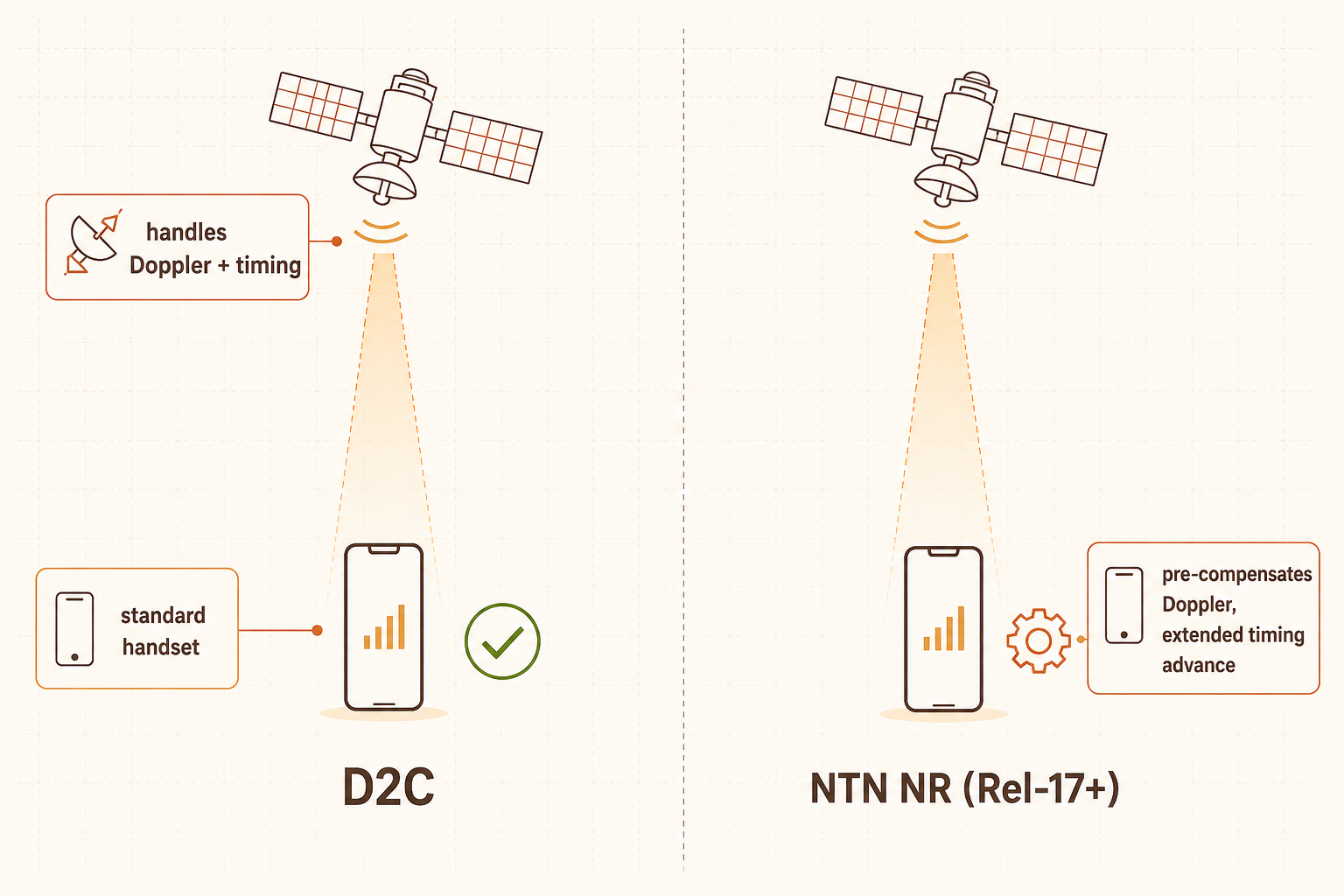
The first is NTN Direct-to-Cell (D2C). Here the satellite operates so that an ordinary, unmodified handset sees it as a regular base station. The phone does not know it is talking to something moving at 7 km/s in orbit. No software update, no new handset—the satellite handles the adaptation on its end. This is attractive commercially because the installed base of existing phones is enormous. The challenge is that doing this cleanly requires the satellite to compensate for all the complications—Doppler shift, propagation delay, timing advance—before the signal reaches the handset.
The second approach is NTN NR (3GPP NR for NTN), standardized beginning with Release 17. Here the handset is NTN-aware. It knows it is talking to a satellite and participates in compensating for the challenges. It can pre-compensate for Doppler based on its own GNSS position, use extended timing advance for the longer round-trip delay, and handle other protocol-level adjustments. The phone needs to support these extensions, but the overall system design is cleaner because the work is shared.
The industry’s standardization momentum sits with 3GPP Rel-17, which actually defines two NTN flavours: a more “IOT”-friendly, low-data-rate track (IoT-NTN, built on NB-IoT and eMTC) and the NTN NR track described above. The former is likely the first to roll out—its simpler protocol stack and existing infrastructure made it the earlier candidate, initially for low-rate messaging and IoT. NTN NR follows, with devices that implement the NTN-specific extensions becoming available over the next several years.
What Starlink actually is—and is not
A clarification worth making explicitly: the Starlink most people are familiar with is not direct-to-cell connectivity. The original Starlink service requires a dedicated terminal—the flat phased-array dish colloquially known as Dishy—installed at a fixed or semi-fixed location. That terminal handles the satellite link and then provides Wi-Fi or Ethernet to devices nearby. A phone connected to Starlink via this route is effectively connecting to a local Wi-Fi access point, not to a satellite. The satellite link is backhaul.
This is a fundamentally different architecture from what “NTN for 5G/6G” implies. In the NTN vision, the phone’s cellular radio—the same radio it uses to call a terrestrial tower—connects directly to the satellite. No dish, no dedicated hardware on the ground, no special terminal.
SpaceX has announced direct-to-cell capability for newer Starlink satellites, and several carriers have signed partnership agreements. But this capability is distinct from the consumer Starlink service, uses different satellite hardware, and is still in early rollout. The earlier generation of Starlink constellation was not designed for it.
The distinction matters because the engineering problems are completely different. A large phased-array dish on the ground can handle the link budget, the pointing, and the protocol adaptation on behalf of the attached devices. A handset must do all of this within the power and antenna constraints of something designed to fit in a pocket.
Why putting a handset on a satellite link is hard
The engineering challenges of NTN are real and substantial. Each one is solvable in principle; the question is how much they cost in performance and complexity.
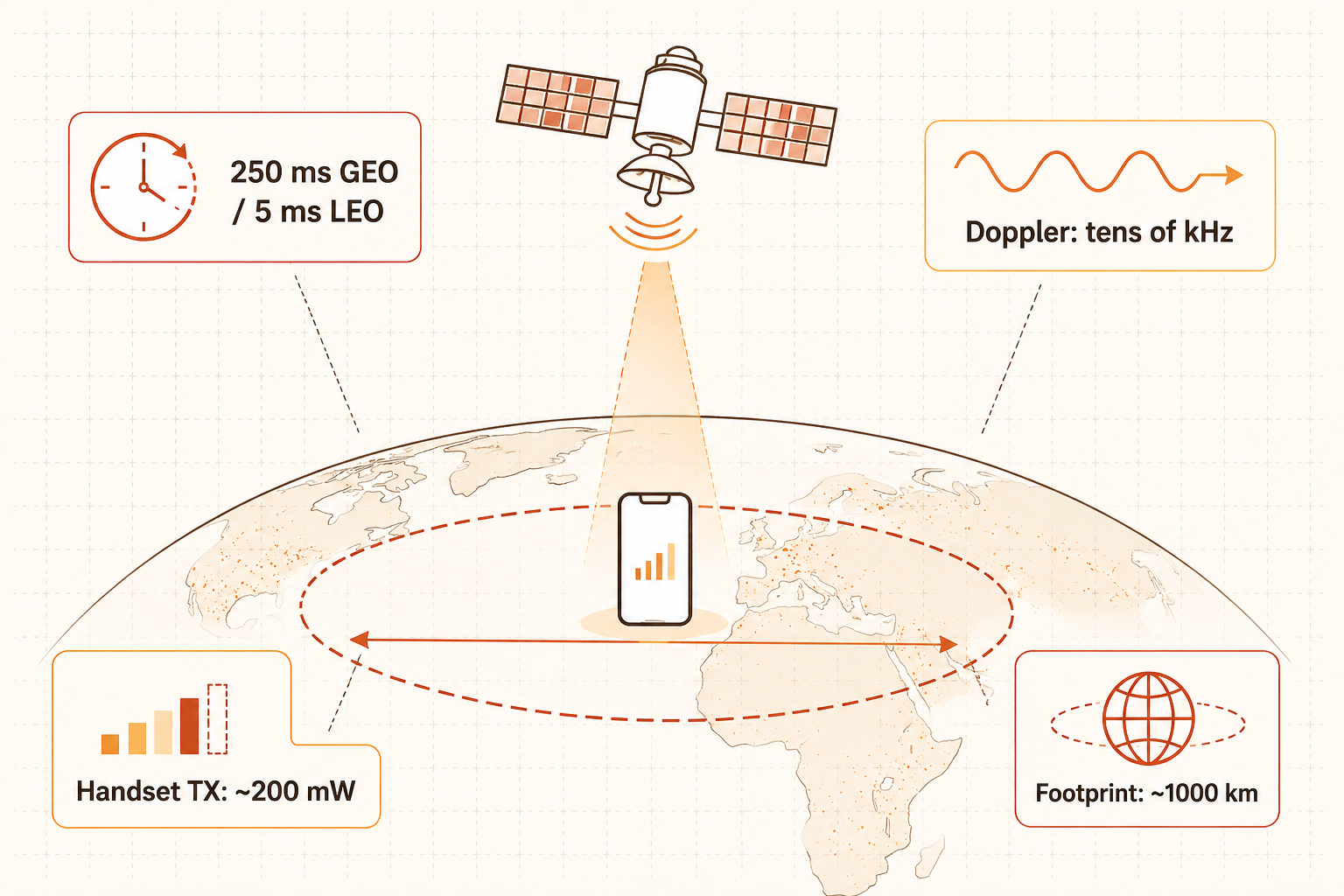
Distance and delay. A LEO satellite orbits at roughly 500 to 2,000 km altitude. Even at the low end, the one-way propagation delay is around 2 to 5 milliseconds—compared to microseconds for a nearby ground tower. Protocols designed for terrestrial cells assume very short round-trip times. NTN NR extends timing advance to handle this, but the delay has ripple effects throughout the protocol stack: random access preambles must be longer, HARQ retransmission timers need to accommodate the longer round-trip, and scheduling becomes harder to do at low latency. GEO satellites at 35,786 km have round-trip delays around 250 ms (one-way propagation alone is roughly 120 ms), which makes low-latency applications essentially infeasible from GEO—LEO is the only viable option for interactive use.
Doppler shift. A LEO satellite moves at roughly 7 km/s relative to the ground. At cellular frequencies, this produces Doppler shifts that can be orders of magnitude larger than those seen in terrestrial channels. A terrestrial channel might see a few hundred Hz of Doppler from a fast-moving vehicle; a LEO satellite can produce shifts of tens of kHz. Standard receiver designs would misinterpret this as a frequency error. NTN NR asks the handset to pre-compensate based on its known position and the satellite’s ephemeris data—which works, but requires that the handset knows where it is (GNSS) and where the satellite is (ephemeris broadcast).
Handset transmit power. A smartphone transmits at most around 23 to 26 dBm (roughly 200 to 400 mW). A base station can transmit at tens of watts. In a terrestrial cell, the uplink from handset to tower is often the limiting link—the tower hears the weak phone, not the other way around. Bridging an additional 500 km with a low-power handset is a link budget problem. The satellite needs large antennas and sensitive receivers to close the link; the handset has essentially no room to increase its transmit power.
Cell size and capacity. A single LEO satellite at 600 km altitude with a reasonable beam pattern might illuminate a footprint several hundred kilometres in diameter. This is not like a terrestrial cell covering a neighbourhood—it is a cell covering a region the size of a small country. The number of users in that footprint can be very large. Massive MIMO and beam-forming on the satellite can subdivide the footprint into narrower spot beams, which is how most modern LEO NTN systems are designed. But each spot beam still covers tens of kilometres, not hundreds of metres, and the capacity implications are real.
Handover. A LEO satellite moves across the sky in roughly 5 to 15 minutes from horizon to horizon. This means handover—from one satellite to the next, or from satellite to a terrestrial base station when one comes into range—happens frequently and must work reliably. Terrestrial handover has milliseconds to execute; NTN handover must be planned well in advance because the geometry is predictable.
Frequency matters more than you might expect
The choice of frequency band has an outsized effect on what is and is not feasible for NTN.
Lower frequencies—L-band (1–2 GHz), S-band (2–4 GHz)—propagate well, penetrate buildings better, and require less transmit power to close the link at satellite distances. Iridium and Inmarsat, which have offered satellite connectivity to specialized terminals for decades, use L-band. The trade-off is that lower frequencies have less available bandwidth, which caps throughput.
Higher frequencies—Ku-band (12–18 GHz), which Starlink’s dish-based service uses for its user link, and Ka-band (26–40 GHz), which it uses for gateway links—offer much more bandwidth and support high throughput to large terminals. But for a handset, the link budget at these frequencies with a small antenna and limited transmit power simply does not close without heroic effort on the satellite side.
For NTN direct-to-cell, the industry is mostly looking at lower frequency bands: S-band and, in some cases, the existing cellular bands (especially the lower ones around 700–900 MHz). This is partly why LTE is first to roll out—LTE has always operated in these bands, and the protocol was designed for them. The frequency choice is not just a performance decision; it determines whether the link is physically possible with a standard handset at all.
The industry is still sorting itself out
NTN is not a solved problem waiting for deployment. The standardization is relatively new—Rel-17 was completed in 2022, with device implementations still maturing. The commercial agreements between satellite operators and terrestrial carriers are being negotiated. The link budget analyses are being validated against real constellations. Several technical questions remain open: how to handle interference when satellite and terrestrial cells overlap in the same band, how to hand over reliably between satellite and ground, what service guarantees are actually achievable given the capacity constraints of a large footprint, and how to handle the regulatory patchwork of different frequency allocations across jurisdictions.
The space is also commercially crowded and fast-moving. AST SpaceMobile, which is targeting direct-to-cell with large-aperture satellites, is at a different stage of deployment than SpaceX’s Direct to Cell programme, which in turn is architecturally different from OneWeb’s or Amazon Kuiper’s approach. Each company has made different trade-offs between satellite size, frequency band, constellation altitude, and target use case. It is not yet clear which architecture will prove most tractable.
Is this the future?
I honestly don’t know.
The coverage argument is real. There are parts of the world where terrestrial connectivity will not appear in any foreseeable commercial timeframe, and satellite NTN is probably the only credible path to connecting them. Maritime and aviation connectivity, which have historically required large specialized equipment, could be transformed by LEO NTN at reasonable cost. Emergency and disaster response use cases are compelling precisely because they need coverage when terrestrial infrastructure has failed.
But the capacity argument is harder. A satellite serving a footprint of hundreds of thousands of square kilometres is not going to replace a dense urban network. For high-traffic environments, the satellite can serve as a fallback—a safety net—not a primary access mechanism. Whether that is worth the complexity of integrating it into the 3GPP stack is a question the field is still working out.
What I am more confident about is that the engineering problems NTN is forcing the community to solve are hard and interesting. Handling large Doppler in a standard protocol stack, closing a link budget to a low-power handset from orbit, doing predictive handover across a fast-moving cell—these problems are accelerating innovation in areas that will benefit wireless systems more broadly, regardless of whether satellite connectivity becomes ubiquitous. In that sense, it is a bit like the moon landing: the goal may not be the point. The engineering dragged along in pursuit of it often is.
This closes the three-part series on 6G’s new scenarios. Next, I will turn to some of the research directions that sit at the intersection of these themes—starting with how AI-native approaches are changing the way we think about channel estimation and resource management in practice.
References
[1] ITU-R, “Framework and overall objectives of the future development of IMT for 2030 and beyond,” Recommendation ITU-R M.2160, International Telecommunication Union, Geneva, Nov. 2023. [Online]. Available: https://www.itu.int/rec/R-REC-M.2160/en
[2] 3GPP, “Solutions for NR to support non-terrestrial networks (NTN),” 3GPP TR 38.821 V16.0.0, Jan. 2020.
[3] O. Kodheli et al., “Satellite communications in the new space era: A survey and future challenges,” IEEE Communications Surveys & Tutorials, vol. 23, no. 1, pp. 70–109, 2021.
[4] F. Rinaldi et al., “Non-terrestrial networks in 5G & beyond: A survey,” IEEE Access, vol. 8, pp. 165178–165200, 2020.